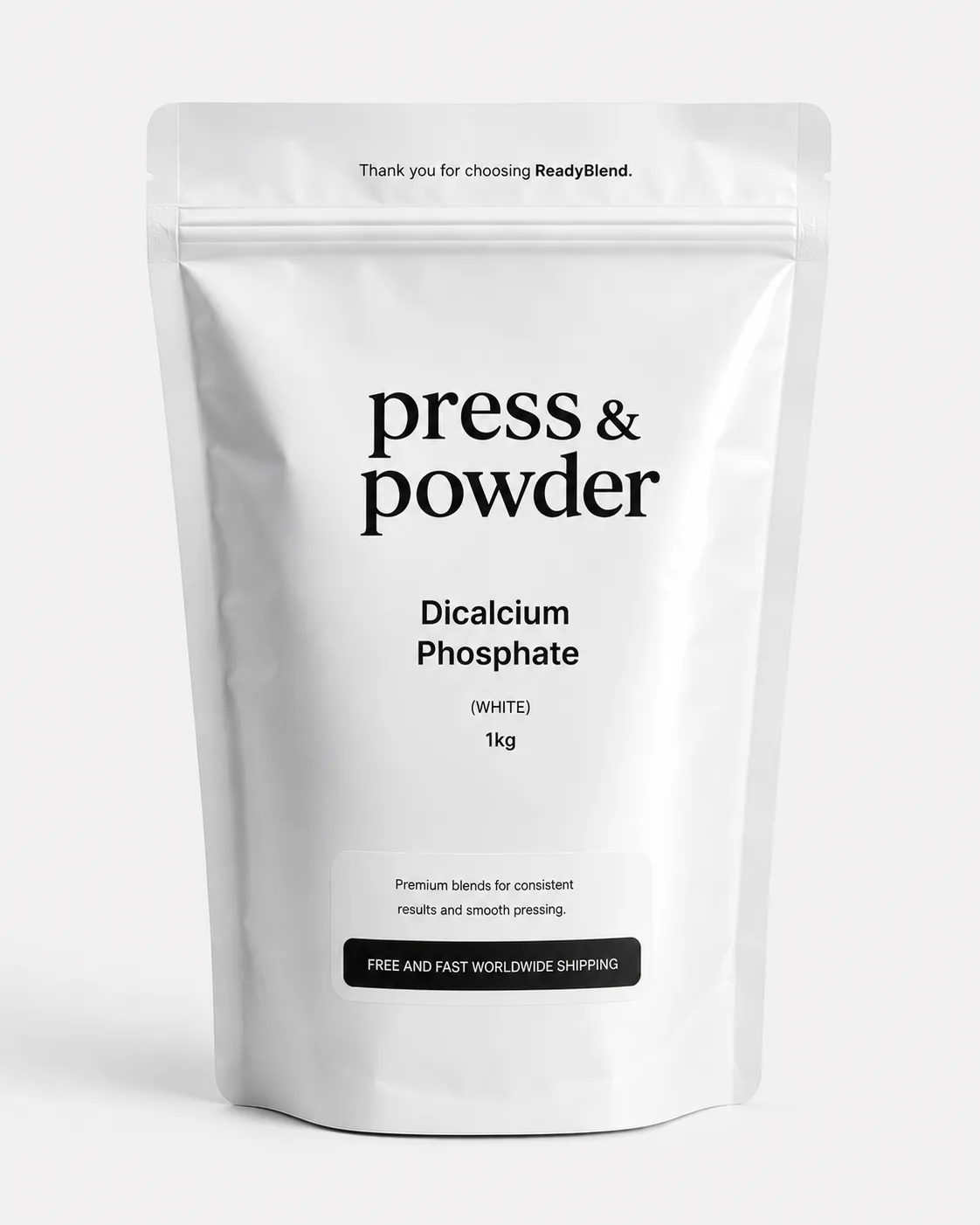
A dense, free-flowing filler for formulations that need weight and flow. Often blended with MCC to balance compressibility against flow rate through the hopper.
Ships in 1–2 days · View cart & checkout
Higher bulk density than MCC, which helps formulations reach target tablet weight without an oversized tablet.
Blending DCP with MCC trades a bit of binding strength for better flow — the two are commonly used together rather than as alternatives.
Contributes calcium and phosphate content, which is sometimes a relevant selling point on its own for nutraceutical and supplement formulations.
Confirm performance for your specific formulation with your own testing before a production run.
| Spec | Value |
|---|---|
| Appearance | White, free-flowing powder |
| Role | Filler / flow agent |
| Physical state | Solid |
| Directly compressible | Yes |
| Typical use rate | 20–35% of the excipient blend (before active ingredient) |
| Approx. mesh size | 100–200 mesh |
| Storage | Room temperature, sealed container |
| Bag sizes | 1 kg, 2 kg, 5 kg |
| Bulk sizes | 500 kg, 1 ton, 2 ton, 5 ton pallet lots |
As a filler and flow agent in direct-compression formulations — it's denser and flows more freely than MCC, so it's typically blended alongside it rather than used as a full replacement.
20–35% of the excipient blend is a typical starting range, balanced against MCC for the rest of the filler system. See our guide on building a direct-compression blend from scratch.
No — they're complementary. MCC contributes most of the binding strength, DCP contributes flow and bulk density; most custom formulations use both.
4.7 out of 5, based on 3 reviews.
Noticeably better flow than straight MCC blends we tried before. Hopper doesn't bridge anymore.
Good bulk density for our calcium-forward formulation. Consistent between bags.
Does what we need for flow, though we still had to dial in the ratio with MCC ourselves.